
Race to the Skies - the eVTOL Uprising
The innovative SLICE6 AIR technology addresses the unique challenges faced by eVTOL flight test engineers, allowing manufacturers to accelerate development timelines while collecting reliable and accurate data.
eVTOL Flight Testing - Redefine Possible with DTS
Electric Vertical Take-Off & Landing Vehicles (eVTOL) are a promising solution for urban air mobility (UAM). As eVTOL companies work at a fast pace to be one of the first to get field-approved vehicles, the need for efficient and effective flight testing is critical. Flight testing is necessary to optimize performance and to ensure that safety regulations are met. This new, and rapidly developing technology, has companies pursuing unique designs for a variety of applications including:
This new, and rapidly developing technology, has companies pursuing unique designs for a variety of uses including:
- Urban Air Mobility (UAM)
- Cargo Delivery
- Search & Rescue
- Defense
- Environmental Monitoring
- Personal Transportation
- Medical Services
Find out how DTS can help you overcome your Aerospace Testing Challenges.
4 Key Challenges in Testing eVTOL Aircraft
CHALLENGE #1 - Size, Weight, and Power Constraints
Traditional flight-testing instrumentation (FTI) is often bulky, adding weight and
generating excess heat, posing reliability and performance challenges.
CHALLENGE #2 - Complex Cable Management
Typical centralized data acquisition systems require extensive cabling, posing issues for rotary-wing vehicles like eVTOLs due to the use of slip rings which can increase maintenance and budget, and affect data fidelity.
CHALLENGE #3 - Flight Test Prep Time
Installing centralized DAU is time consuming, requiring dismantling of the aircraft to run analog sensor cabling from various points back to a central location.
CHALLENGE #4 - Lead Times
Specialized flight test instrumentation systems and supply chain issues in the aerospace industry create longer lead times interfering with eVTOL test schedules, aircraft development, and field approval.

Solving eVTOL Testing Challenges
The DTS SLICE6 AIR data acquisition system overcomes key challenges in eVTOL testing, making what seemed impossible, possible.
- Size, Weight, and Power (SWaP) Optimized
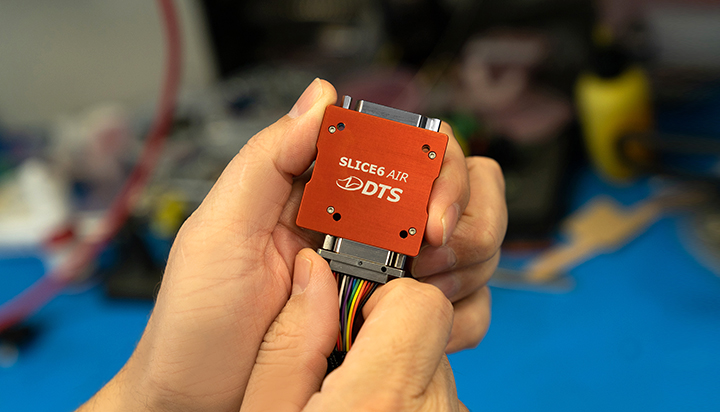
The SLICE6 AIR is the most SWaP-optimized data acquisition unit on the market today. Weighing just 50g, this unit uses less than 3w power consumption significantly reducing heat generation and power supply requirements. - Adaptability & Flexibility Minimizes Cables
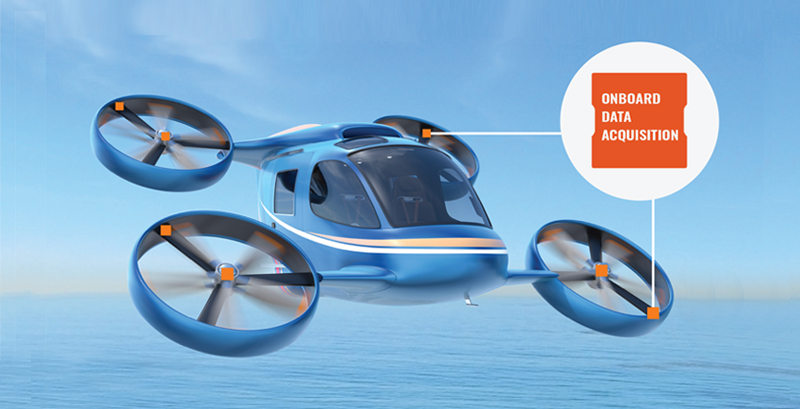
The compact SLICE6 AIR enables decentralization and distribution so can be embedded on, or in, the test article near sensors. This reduces the need for slip rings and extensive cabling, reduces heat and simplifies modifications. - Shorter Flight Test Prep Time
The distributed system not only means faster setup with fewer cables, but it can also be quickly removed, or components replaced, without re-wiring. This allows eVTOL manufacturers to adapt the system as testing needs evolve. - Shorter Lead Times - Faster to Market
DTS currently has the shortest lead times on the market so test engineers are able to keep up with the aggressive testing timelines companies are experiencing as they race to get field approved.
eVTOLs - The Future of Aviation?
The SLICE6 AIR addresses the unique challenges faced by eVTOL flight test engineers as the world ushers in this new exciting new technology.
Theoretically, eVTOLs do provide benefits over traditional modes of flight transportation. They are quieter and produce zero-emissions, making them more environmentally friendly. They can offer efficient maneuvering and, of course, don’t require long runways. Like electric cars, their range will be limited, and they will be subject to different Federal Aviation Administration (FAA) certifications from conventional aircraft. Learn more by visiting FAA's page on eVTOLs at faa.gov/air-taxis.